
Septic tank repairs
Repairs for leaks and cracks in the tank, damaged lids and risers, and failed inlet or outlet connections. Repairing the tank keeps untreated wastewater from escaping and protects the drain field from solids.

Septic repair and installation
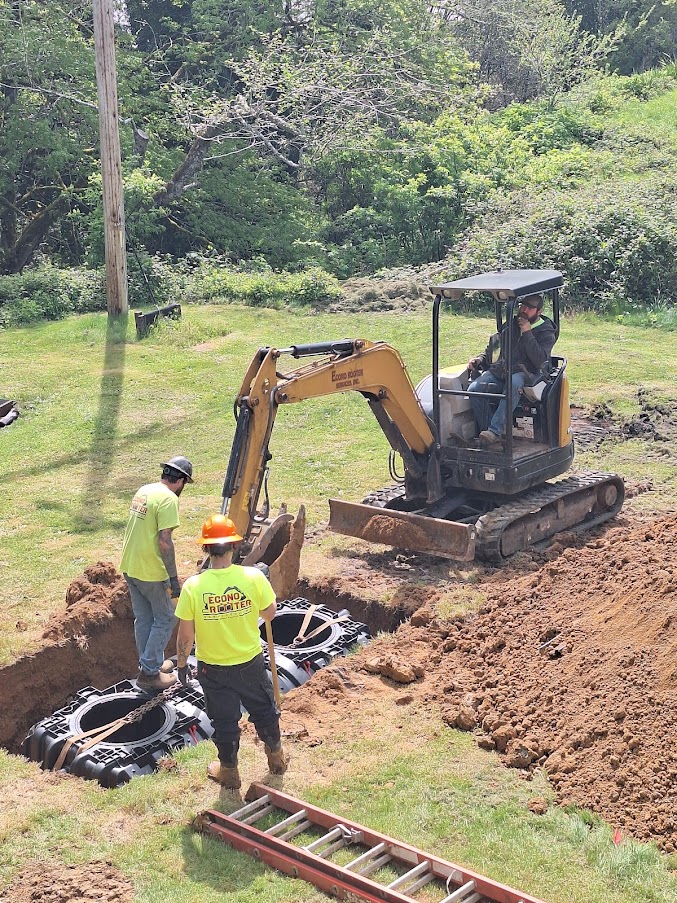
Econo Rooter Services, Inc. repairs and installs septic systems for homes and businesses in Coos Bay, Coquille and across Coos and Curry County. The work covers septic tank repairs, septic pump repair, drain field repair and new septic system installation by an Oregon DEQ licensed installer, including advanced treatment units.
How septic repairs start
Most septic repair calls begin with a symptom: a toilet that backs up, a sewage smell in the yard, or wet ground that will not dry out. The same symptom can come from very different problems. A full tank needs pumping. A failed pump or float switch needs repair. A cracked tank, a broken inlet or outlet connection, or a drain field that has stopped accepting water each need their own fix, and pumping alone will not solve any of them.
That is why every septic repair starts with an assessment of the tank, the pump and controls if the system has them, the lines between components, and the drain field. Because Econo Rooter Services also pumps tanks and works on sewer lines, the team can rule out each possibility and recommend the repair that addresses the cause, rather than a part that only treats the symptom.
When the assessment shows that a system cannot be repaired, or a property needs a septic system for the first time, the work moves to a new installation, which starts with a site evaluation.
Warning signs
Some septic symptoms only mean the tank is due for pumping. The signs below point further: to a failed component, a damaged tank or a drain field problem, which is why they usually continue after the tank has been pumped. If you have not had the tank pumped recently, start with the signs your septic tank is full.
Our septic repair and installation services
Repairs for leaks and cracks in the tank, damaged lids and risers, and failed inlet or outlet connections. Repairing the tank keeps untreated wastewater from escaping and protects the drain field from solids.
Diagnosis and repair of septic pumps, float switches and alarms on systems that pump effluent to the drain field or a treatment unit. Pump, controls and alarm are checked together so the right part is repaired.
Repairs to drain field lines and distribution components when the field is not accepting or spreading water as it should. The assessment looks at soil saturation, damaged pipe and upstream causes first.
New and replacement septic systems installed by a DEQ licensed installer, from conventional systems to advanced treatment units such as Orenco AdvanTex and Delta Whitewater. Each system follows a site evaluation and permit.
Repair or replace
Replacing a septic system is a bigger project than a repair, so the goal of every assessment is to find out whether a repair will restore the system. These are the situations that usually decide it.
Local conditions
Properties across Coos and Curry County sit on coastal terraces, river valleys and steep hillsides, and soil and groundwater conditions change from one lot to the next. Those conditions decide what kind of septic system a property can use, which is why a new system starts with a site evaluation rather than a standard design.
Where soil drains well and groundwater sits deep enough, a conventional system may work. Where it does not, the design changes, and an advanced treatment unit may be used to treat wastewater before it reaches the drain field. Those units then need scheduled maintenance.
Long, wet winters keep coastal soils saturated. Excavation and soil work are easier to plan for drier months, so projects that can wait are often scheduled with the weather in mind, while failures that cannot wait are handled as they happen.
Rural lots bring long driveways, slopes and tight spaces between buildings, wells and property lines. Planning where equipment can reach, and where the tank and drain field can go, is part of every installation.
Our process
The tank, pump and controls, connecting lines and drain field are checked, along with the site itself, so the recommendation addresses the cause of the problem.
Repair or replacement options are explained in plain language, with a quote and any permit requirements, before work begins.
The work is carried out by a DEQ licensed installer, with excavation and equipment planned around the property and its layout.
The system is tested once the work is done. New systems also go through the permitting agency's final inspection, and you are shown what was done and what to watch for.
Licensed septic installer
Septic installation and repair in Oregon are regulated work, and permitted septic systems must be installed by a business licensed by the Department of Environmental Quality. Econo Rooter Services holds Oregon DEQ Installer License #38122 and a DEQ septic pumping license, along with an Oregon plumbing license (#6-81PB), a limited electrical license, and DEQ recognition as an installer of advanced treatment technologies, including Orenco AdvanTex and Delta Whitewater units.
Holding all of those under one company matters on a repair. The team that pumps the tank can find the failed component, repair it, maintain an advanced treatment unit afterward, and work on the sewer line that feeds the system. You can review every license on the certifications page.
Septic repair and installation questions
A septic system usually needs repair when one component has failed, such as a pump, a lid or a connecting line, while the tank and drain field still work. Replacement becomes likely when the tank is structurally failing, the drain field no longer accepts water after repairs, or the system is too small for how the property is used. An on-site assessment shows which situation applies.
The cost of septic work depends on what has failed, how much digging is needed, access for equipment, and for a new system, the site evaluation results, the type and size of system the site requires, whether an advanced treatment unit is needed, and permit requirements. Econo Rooter Services quotes after assessing the specific property.
The time to install a new septic system depends mostly on steps that happen before digging starts: the site evaluation, system design and permit approval. Weather and soil moisture also matter on the South Coast, since wet ground slows excavation. Repairs to a single component can usually be scheduled sooner than a full installation.
Onsite septic systems in Oregon are regulated under Department of Environmental Quality rules. New systems require a construction permit, and many repairs require a repair permit from the agency that handles onsite permits for the county. Econo Rooter Services can tell you what your job requires when it assesses the system.
Some septic pump problems come from a float switch, an alarm or an electrical connection rather than the pump itself, and those can often be repaired. A pump that has worn out or burned out is usually replaced. Checking the pump, controls and alarm together shows which applies before any parts are ordered.